

Public Participation and Universal Education
Education is the cornerstone of any empowerment process. Without elevating knowledge and skills, no development program can lead to economic independence and social sustainability. Within Morvarid village, Matmaa’s Corporate Social Responsibility (CSR) strategy is anchored on the principle that effective support gains true meaning only when it cultivates individual agency and strengthens the collective capacity of local residents.
Grounded in this framework, professional technical-vocational training for local women and the ‘ABA’ literacy initiative were strategically designed to foster sustainable human resource agency. These initiatives focus on transferring practical skills, securing accredited professional certifications, and unlocking economic avenues for utilizing this knowledge—ensuring that education directly translates into empowerment and enhances the professional and academic standing of the community.
Technical and Vocational Training
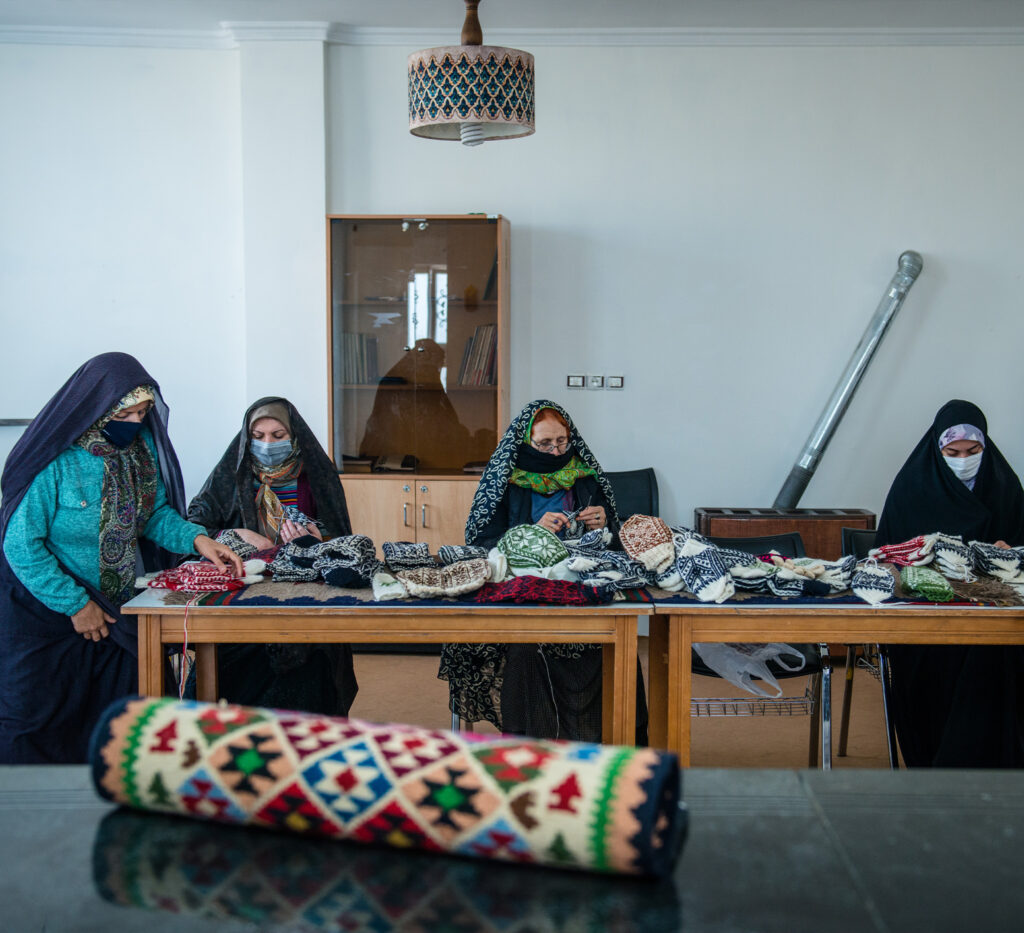
In Morvarid village, the primary host community adjacent to the Morvarid Iron Ore Mine, women traditionally lacked participation in external economic activities. This paradigm was subsequently transformed by establishing two women-led catering kitchens for the mine’s workforce and sourcing handcrafted local products for corporate and seasonal gift packages. Furthermore, specialized training courses were conducted by certified instructors from the National Technical and Vocational Training Organization, enabling participating women to secure official vocational certifications in their chosen fields.
More Information
In Morvarid village, the primary host community neighboring the Morvarid Iron Ore Mine, women traditionally lacked access to formal, full-time economic activities. However, field interactions led by Matmaa’s CSR facilitators revealed a strong local desire for home-based or village-centric, part-time employment. By evaluating existing skills, community capacities, and micro-employment opportunities, the following sectors were designated for technical-vocational training:
- Commercial Cooking and Pastry Making
- Professional Sewing and Tailoring
- Textile Weaving (including Rug, Kilim, and Woolen Sock weaving)
A core strategic criteria in selecting these educational fields was ensuring that the products and services generated by these women could be procured directly by the mine or integrated via local subcontracts. This vision was realized through the operational launch of two women-led catering kitchens supplying meals for the mining personnel, the activation of sewing workshops to manufacture industrial workwear for the mine’s workforce, and the ongoing procurement of local crafts for corporate and seasonal gift packaging. Delivered in partnership with certified National Technical and Vocational Training Organization instructors, these courses culminated in the participants successfully passing national examinations and earning accredited professional vocational certifications.

The 'ABA' Literacy Initiative
In 2021, Matmaa Mining Group pioneered its partnership in the ‘ABA’ (Reconciliation with Education) literacy framework. Twenty-four village residents who had dropped out of the formal school system and qualified for adult education registered for this program, successfully advancing their education to earn their high school diplomas.
More Information
A significant challenge across rural communities is the premature discontinuation of formal education before reaching high school graduation. This issue stems from various socio-economic factors, including the lack of higher-grade schooling facilities within the village, cultural paradigms regarding girls’ education that prioritize early marriage, and the economic necessity for young boys to enter the workforce early. This structural bottleneck was highly prevalent in Morvarid village, and no viable solution had been established for interested youth and adults until 2021, when Matmaa Mining Group committed to sponsoring the ‘ABA’ (Reconciliation with Education) initiative.
Launched under a memorandum of understanding signed in May 2021 between the Iranian Organization for Mining Engineering and the Ministry of Education, the ‘ABA’ framework utilizes a tripartite partnership model combining a corporate financial sponsor, a distance-learning school, and the local student demographic.
Driven by the dedicated outreach of Matmaa’s CSR unit, 24 school-dropout residents eligible for adult education enrolled in the program. Matmaa Mining Group acted as the primary financial patron for the academic year (2021–2022), fully backing the community’s return to education. Facilitated by the local village CSR officer, the program effectively deployed a hybrid model of on-site and remote learning, localized remedial classes, and semester-based examination coordination. Building on this momentum, 20 additional residents sustained their secondary education through the ‘ABA’ framework in subsequent years, culminating in their successful graduation with official high school diplomas.